
The totemic power of childhood landscapes

I have been contemplating today my experience as a playing child, growing up in Brisbane in south east Queensland, Australia. Brisbane in the 1970’s was a great place to be a child, and this had a lot to do with the abundance of swimming pools and the warm tropical swimming weather that persists for about 9 months of the year. More specifically, though, I had access to two landscapes that were instrumental in my development as a creative individual, and in shaping my relationship to the city and the environment in general in adult life. These were known to me respectively as ‘the creek’ and ‘the city’.
‘The creek’ was the Bulimba Creek, which winds through Southern Brisbane’s outskirts in rough bushland, or at least it did when I was a child. It has been largely contained by now, and lost its sense of endless extension into bush. In the photo above you can see that it is now more clearly bounded by developed areas - the creek is the trapezoidal green space in the middle of the photograph. My old house is indicated by the pink marker.
The creek was a landscape of wonder and endless discovery, and held such exciting features as the Mysterious Cube (a vast, rusting steel boiler canted on an angle in the actual bed of the creek); a number of rusting car bodies in different locations; the Big Tree that had fallen across the creek, providing an excellent and useful bridge; and slightly further afield, The Cliff, an escarpment around a gully. Even further afield - as far as Wecker Road, if you could bother to walk that far in the heat - you could find the Ruined Farmhouse, visiting which seemed illicit in some ill-defined way.
These landmarks loomed large, and their presence in the landscape of the creek was totemic, or mythological. It is not that I thought they were magical - it is just that they were definitive features, wholly specific, and more than a little dangerous in each their different ways. They were there, and they were a bit wild, and that was enough.
I would return home from School and go ‘down the creek’, and thus spent hours wandering the hidden tracks and paths, finding bolt-holes and uncovering those aspects of the place that were far from obvious to the casual (adult) observer. There was a tightly defined circuit, a network of paths that could be traversed, and many branches that could be negotiated to arrive at various destinations, each of which had a particular character different to the others. The bushland had fingers radiating into the surrounding suburb, and by navigating the creek paths you could get yourself to nearly anywhere you might want to be, passing into bushland here and out again there as if negotiating secret passages in an old house. In fact, it felt a lot like doing just that: a parallel world that had branches and outlets everywhere in the ‘real’ world, a way of bypassing the everyday and moving in secret.
If this was the home ground, its opposite number, no less exciting, was Brisbane City itself. At the relatively young age of 11 or 12 I was allowed to hop on a bus and go ‘downtown’, and having done so for years with my grandmother and mother, I could then visit the various different landmarks and territories of the city on my own, exploring at will. Brisbane has some grand architecture, and I was particularly drawn to the older sandstone buildings that were extroverted and urbane, buildings such as the Macarthur Building on Queen Street and the Brisbane City Hall on King George Square.
I would enter City Hall through the big doors, between the bronze lions, and walk the circuit right around the hall looking at the Alderman’s names stenciled on the glass in gilt letters, from the Mayor’s office to the various other chambers and spaces. I remember liking the fact that you could walk all the way around in a circuit and lose track of where you were, with doors to the offices on the outer side and doors to the great assembly hall on the inner side. Little did I know that years later I would be a close friend of the architect’s great grandson, David Bullpitt, himself an architect of no small ability.

The City provided the opposite of the creek in most respects, but in one respect they were identical: they both possessed a sense of danger, and a sense of the illicit, or forbidden. Need I say that this was their chief appeal? To a bookish, church-going little boy, both landscapes, and my pronounced freedom within them, offered endless possibilities.
I am now 39 years old, but the totemic influence of these two landscape archetypes is still strong for me. I am fascinated by their psychological importance to me even now. I now live in the inner city of Melbourne, right on the downtown grid, and it still gives me an ill-defined thrill, even if the ‘city’ of Melbourne is less ‘urban’, in its physical setting and atmosphere, than downtown Brisbane seemed to me as a child, with its dramatic plunge down into the River.
I sincerely believe that I could only truly feel at home living in one of the two archetypes from my childhood: a bushland setting, or the absolute inner city. Or, as a friend put it once, ‘either completely out or completely in’. Certainly I have gravitated to those extremes as an adult; for now I am living the latter condition, but perhaps at some point in my life I will revisit the former. It seems to me that a life spent moving between the two is nothing to regret.
Dumb, simple, wonderful
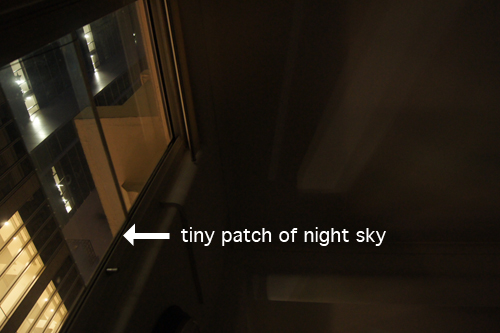
Thursday night after ten pm I spent more than an hour watching clouds scud by the tops of the highrise towers outside my apartment. I was so intrigued by the appearance of the cloud banks, the tops of the buildings and the occasional visible star (there were two, but I think one was a planet) that I dug out my Sony DSLR and experimented with some long exposure shots.
As a photography session it was of limited success. I don't really know what I am doing with that camera, but I managed to get some mildly interesting and evocative snaps, more of interest as documentation than art. One is shown above. In one respect, however, the evening was a complete success: it was really relaxing doing something so harmless and random. I had a similar sensation at Christmas, when I spent about half an hour blowing soap bubbles with my niece Orli and my dog Lucy. Both Orli and Lucy liked to chase the bubbles, and I liked to see how many I could blow with one breath. There is something so engaging about doing...harmless, stupid nothing! I recommend it.
Of course, my evening came good last night almost as soon as I had turned off the television. It is so liberating to suddenly silence that dreadful device, and a calm settles on the apartment almost instantaneously. The room 'depolarises' - it is no longer a tunnel pointed at the screen - and I can hear myself think. In this state I turned my mind to alternative forms of entertainment - I'm not a monk, after all - and I settled on the digital comic. The iPad was made for comics, but they take quite a while to download. While I was waiting I got in the habit of staring up at the clouds, which I could just see from my reclined position on the sofa. Waiting for comics slowly became more interesting than reading comics, and the aforementioned photo session ensued.
This particular patch of sky is, relatively speaking, tiny - but no less captivating for that. Certainly I can see more sky out of my western windows. However, given the choice of being down near the street or up near the clouds, I think I would still stick with down near the street, looking up at the clouds. What's that Wilde quote - we are all in the gutter, but some of us are looking at the stars? That's how I like it. In my apartment, my floor level is about ten feet above the heads of pedestrians walking on the pavement below, so I am not too low, but I still feel connected to what is going on. Certainly I hear and see everything that happens outside, but safe in my perch, passersby can't really hear or see me going about my business. To be just above street life, and yet able to see the sky - that's the perfect balance.
In the last few years, I have probably only had half a dozen nights spent in without the television to provide its chattering company. I would like to see the television become the exception, rather than the rule, of a night spent alone in the company of my various companion animals. I don't see any real obstacles to this: I enjoy a measure of evening and weekend solitude, which balances out my busy, people-filled week days. Quite apart from the refreshing contrast, I am also interested in this condition of solitude that Rainer Maria Rilke discusses in his 'Letters to a Young Poet'. Rilke speaks of a need to 'scale the depths of solitude' in order to find the inner impulse to be creative. I like this, not the least for which it forms such a pleasant contrast to the relentlessly 'social' agenda of new media and technology. The idea of creative production being deeply personal and driven by a quiet solitude is a contradictory note in these collaborative, connected times, and this alone recommends it for further attention.
Alternatively, I might invest in some detergent, bend a wire coat-hanger and spend my evenings blowing bubbles at my dog. It's all good.
A Project for the New Year
A new year begins, and the heart turns to the question: what is the creative project for this year? Of course, the day job keeps me in plenty of creative work - architectural and urban design, to be specific - but there is always a personal project or projects of some type bubbling away in the background, to be serviced after hours, run wholly on passion. First, the little stuff: I would like to learn how to use my beautiful Sony DSLR properly some time this year, and I am thinking of doing a private course at a local photography outfit. The shop is called 'Michaels' and they have been selling cameras and promoting photography in Melbourne city since early in the 20th Century. They run interesting courses for photographers of all levels. The city is my subject: Melbourne is very photogenic, and there is much to discover behind the lens. So that's strike one.
I would also like to attempt some random sketching and drawing around the city, something that I have neglected in the last few years. I always used to draw, but now I seldom find time to do so outside of work, which is not a good state of affairs. The tools need sharpening, as they say. Strike two: drawing.
The major project is neither drawing nor photography. My major project this year, like last year, is writing. Late last year I began to investigate the process of writing fiction. There is a book project inside my head, and I suspect that fiction will happen some time in the near future, but this year I want to expand my freelance writing activities into a related non-fictional project.
Here is what I know so far. The book will be about design. The book will be personal, and something akin to a personal philosophy of design as a process and an activity. The book will be an exorcism of some of the more noxious habits of thought and process that I picked up at University, and although that is now some 12 years in the past, I am still processing the lessons - good and bad - learnt at the institution. I recently described this post-educational state of mind as a 'hangover'. It is time to move on.
Such a quaint project would never have occurred to me before now, as I was raised academically on the gloomy post-structuralist perspective that subjectivity is unavoidable, but irretrievably flawed. In a world where all value is relative and all knowledge subjective, what is the point of staking out a personal territory? We might as well mire ourselves in irony, cynicism and the particularity of the banal, or so the argument goes. Now I am not so sure, and I would like to explore my set of values in relation to my native field, which is architecture. So using this as my starting point, my creative project for 2011 is to start digging back into my past, to re-engage with the less-burdened creative self of my childhood and teenage years, and rediscover the simple magic of making and discovering, unencumbered by the constant self-doubt of a post-structuralist education. This is indeed a personal project, and I can only take it on faith that there will be something in it for the reader, who may relate to my situation.
2011: here I come, ready or not.
I would also like to attempt some random sketching and drawing around the city, something that I have neglected in the last few years. I always used to draw, but now I seldom find time to do so outside of work, which is not a good state of affairs. The tools need sharpening, as they say. Strike two: drawing.
The major project is neither drawing nor photography. My major project this year, like last year, is writing. Late last year I began to investigate the process of writing fiction. There is a book project inside my head, and I suspect that fiction will happen some time in the near future, but this year I want to expand my freelance writing activities into a related non-fictional project.
Here is what I know so far. The book will be about design. The book will be personal, and something akin to a personal philosophy of design as a process and an activity. The book will be an exorcism of some of the more noxious habits of thought and process that I picked up at University, and although that is now some 12 years in the past, I am still processing the lessons - good and bad - learnt at the institution. I recently described this post-educational state of mind as a 'hangover'. It is time to move on.
Such a quaint project would never have occurred to me before now, as I was raised academically on the gloomy post-structuralist perspective that subjectivity is unavoidable, but irretrievably flawed. In a world where all value is relative and all knowledge subjective, what is the point of staking out a personal territory? We might as well mire ourselves in irony, cynicism and the particularity of the banal, or so the argument goes. Now I am not so sure, and I would like to explore my set of values in relation to my native field, which is architecture. So using this as my starting point, my creative project for 2011 is to start digging back into my past, to re-engage with the less-burdened creative self of my childhood and teenage years, and rediscover the simple magic of making and discovering, unencumbered by the constant self-doubt of a post-structuralist education. This is indeed a personal project, and I can only take it on faith that there will be something in it for the reader, who may relate to my situation.
2011: here I come, ready or not.
Finish with a diagram

I think that this concisely summarises my current state of being. Today I make the transition from work-state to holiday-state, and for me Christmas is a time of cloudy speculation and dreamy, idle thought. I always make time to see some art - typically at the National Gallery of Australia in Canberra, where I am staying for the break - and this always prompts new thoughts and a different outlook. The Gallery has also just opened its new extension, and I look forward to seeing the Aboriginal Art in the new wing. It is meant to be quite spectacular and I have been looking forward to it. Who knows what I might be prompted to post in light of such rare stimulation.
Merry Christmas to all readers, and a Happy New Year!
A thought for Christmas

Christmas is upon us again, and I was thinking about the way that dressing up a house influences our experience of the yuletide season. Personally, I don't decorate my apartment. It is all I can do to keep a tidy apartment, and I know that if I decorated it there would be tinsel and bunting up until April. There is also something vaguely maudlin about a single-person household that is decorated - particularly when you don't entertain very often. I don't know why, but this seems to be the case. After all, the various animals I cohabit with would not really appreciate the effort, although my dog Lucy was seen last Saturday enthusiastically drinking water out of a friend's Christmas tree stand.
Part of me wants to decorate, or to get a tree, as I think a house becomes more of a home when you mark the seasons and cycles of the year, such as they are in our streamlined 24/7 society. Contemplating this put me in mind of the 'good' room - the idea of a room in the house, or in the case of many friend's houses when I was growing up, entirely half of their living spaces, dedicated to infrequent and selective use. Real estate costs significantly more now than it used to, as a percentage of our incomes, and certainly in apartment living the idea of having enough space to dedicate some to formal use only is something one can only dream of.
Nevertheless, I would like to raise a banner in defence of 'useless' or 'unnecessary' space, and I think that the matter has some bearing on the location of the Christmas tree. A house with a formal room or suite of rooms is to my mind enriched. Such a space is not only an excellent receptacle for seasonal and occasional decoration; it also brings a hierarchy to a house, a layering of personal territory whether used exclusively by infrequent visitors or not. I suspect that it makes the casual living spaces even more casual to have them contrasted with a suite of formal rooms. Nevertheless, in my rooms on Collins Street here in Melbourne, there will be only one class of space for the foreseeable future: the eclectic, quasi-casual, pleasantly-rumpled, vaguely untidy semi-catastrophe that is my personal habitat.
You may visit wearing shorts or a tuxedo: at Casa Marcus, one size fits all. And I thank the great Diane Arbus for the image above, reproduced without permission in celebration of the yuletide season.
Diagramming the Long Project
This is a diagram of the process of writing and publishing an entry into the Long Wall feed. It remains to be seen whether my lovely diagram helps to explain the Long Wall Project, or whether it just obscures the picture further! Let me know your thoughts.

A Long Project
 Margaret Ballardini & Fred Watson, St Kilda 1927
I have an idea for a project that might be of interest to the Long Now Foundation, of which I am a card-carrying, 'Stainless-Steel' class member. The Long Now Foundation (www.longnow.org) hopes to 'creatively foster responsibility in the framework of the next 10,000 years', so it is fair to say that it is a Foundation with a long-term view of humanity and its challenges. I find this very exciting, so I am happy to pay my annual membership fees to be counted among those who support the Foundation.
My project is called the Long Wall, and the title is a play on the biblical story of the 'writing on the wall', a phrase that has entered common usage. I have registered the URL longwall.org in anticipation of making something of it in due course. Like other Long Now Foundation projects the premise is quite simple, and the project has a certain quality of aesthetic minimalism. Here's the idea.
I want to set up a website that publishes a feed of text supplied by users. Nothing complicated about that. The feed is like a ticker-tape, or like a slowly emerging blog, with posts published periodically. The feed will then become a record of posts, much like a blog archive.
The twist is that I want the site to delay the publishing of each user's entries into the 'feed' by a certain precise time period after the user hits the 'publish' button, and that time period is equal to the number of words in the entry multiplied by one lunar month for each word. Therefore, the publishing of a 101 word entry into the feed would be delayed by 101 lunar months; a 6 word entry delayed by 6 lunar months, and so on. In this way the feed will stand as a document of entries, thoughts, ideas and proclamations made in the past. The longer the entry, the greater time between when it was written, and when you read it in the feed. If you read a freshly published 1000 word entry, you know that it was written nearly 81 years prior to its appearance in the feed.
This is partly an exercise in constrained writing, and partly an exercise in 'time-capsuling'. I have thought long and hard about the size and nature of the time period multiplier. Using a multiplier of 1 year would be stately, but I fear it would limit the amount of words people would be inclined to write. Similarly, using a multiplier of a week or a day would be too quick and negate the qualities of the experiment.
The lunar month is 29.53059 days, or 29 days, 12 hours and 44 minutes and 3 seconds. It has the benefit of being built into the mechanics of our solar/lunar system, and it will change only fractionally over 10,000 years. In the next 10,000 years there will be approximately 123,600.645974 lunar months, so there is a lot of scope for creative expression. This also means that the average PhD thesis would be delayed by several thousand years, which is probably no great loss.
If I get sufficiently excited about the project I will work up some screenshots, and I might even pitch it to my fellow Foundation members. Stay tuned for more in future posts.
Rewiring your brain - like it or not
Mr. Nicholas Carr has written a little book called 'The Shallows', within which he develops the argument that our incessant internet use is literally and physically reshaping our brain and memory structures, and that the older habits of deep reading and deep thinking are being displaced.
I cannot repeat the entirety of his argument here, of course, but it is compelling, drawing on neuroscience as much as history and current behavioral research.
Carr and others he quotes describe the internet as a 'distraction machine', and he delves into the questions of cognitive load and the relationship between distraction and comprehension and memory. The argument is so compelling that I have been prompted to rethink how I do a lot of different activities, spanning both work and leisure, and after a quick audit of my own habits I can definitely say that I have been exhibiting the symptoms Carr describes.
My first reaction to this has been to read Carr's book thoroughly, and I have about a quarter of the volume left to go. This can be contrasted with the habit of skimming that I had picked up over the last few years, where I would skim and drop a book, rather than allow myself time and effort to read it deeply, as I would have done in the past. Last Saturday I read Carr's book for about six hours in a single sitting. It is a long time since I had experienced this - Carr himself points to the lost art of 'losing oneself in a book' - and it was a great pleasure rediscovered.
The second habit I am rethinking is email. I have set my email client to retrieve mail only once every hour, and I might restrict it further subject to the findings of my trial. I am consciously not visiting the email app to see 'what's come in', and trying to focus deeply on the task at hand, whatever that may be.
That just leaves a persistent Facebook and Twitter feed, chiming away on my iPhone. The phone also buzzes lightly whenever I receive an email. All of these distractions must be mastered.
In the spirit of de-cluttering and winding back the distraction potential of my own little corner of the internet, I have redesigned my website using this simple, low-distraction format. I am also going to rely a little less on imagery in future posts. This might make the site less visually appealing at first glance, but I think the benefit is that there will be no extraneous illustration, and more focus on the contents of my writing. I think the new format is also easier to read, which I am coming to appreciate more as my eyesight ages in a far-from-graceful manner.
In all of this, Carr acknowledges the benefits the internet brings. He is no Luddite, and agrees that there are indisputable positives. More than this, he accepts that there is no going back. Nevertheless, the issues he raises are of such significance that I feel we should all hear what he has to say, and devote a bit of deep thinking to the problem.
I am hearing Nicholas Carr speak tomorrow night. I hope he is as cogent and thought-provoking in person as he is on the page. I will report back forthwith.
I cannot repeat the entirety of his argument here, of course, but it is compelling, drawing on neuroscience as much as history and current behavioral research.
Carr and others he quotes describe the internet as a 'distraction machine', and he delves into the questions of cognitive load and the relationship between distraction and comprehension and memory. The argument is so compelling that I have been prompted to rethink how I do a lot of different activities, spanning both work and leisure, and after a quick audit of my own habits I can definitely say that I have been exhibiting the symptoms Carr describes.
My first reaction to this has been to read Carr's book thoroughly, and I have about a quarter of the volume left to go. This can be contrasted with the habit of skimming that I had picked up over the last few years, where I would skim and drop a book, rather than allow myself time and effort to read it deeply, as I would have done in the past. Last Saturday I read Carr's book for about six hours in a single sitting. It is a long time since I had experienced this - Carr himself points to the lost art of 'losing oneself in a book' - and it was a great pleasure rediscovered.
The second habit I am rethinking is email. I have set my email client to retrieve mail only once every hour, and I might restrict it further subject to the findings of my trial. I am consciously not visiting the email app to see 'what's come in', and trying to focus deeply on the task at hand, whatever that may be.
That just leaves a persistent Facebook and Twitter feed, chiming away on my iPhone. The phone also buzzes lightly whenever I receive an email. All of these distractions must be mastered.
In the spirit of de-cluttering and winding back the distraction potential of my own little corner of the internet, I have redesigned my website using this simple, low-distraction format. I am also going to rely a little less on imagery in future posts. This might make the site less visually appealing at first glance, but I think the benefit is that there will be no extraneous illustration, and more focus on the contents of my writing. I think the new format is also easier to read, which I am coming to appreciate more as my eyesight ages in a far-from-graceful manner.
In all of this, Carr acknowledges the benefits the internet brings. He is no Luddite, and agrees that there are indisputable positives. More than this, he accepts that there is no going back. Nevertheless, the issues he raises are of such significance that I feel we should all hear what he has to say, and devote a bit of deep thinking to the problem.
I am hearing Nicholas Carr speak tomorrow night. I hope he is as cogent and thought-provoking in person as he is on the page. I will report back forthwith.
A new look for A Flawed Mind
A new day and a new look for A Flawed Mind. I am reading the book 'The Shallows' by Nicholas Carr, and I am hearing him speak on the coming Wednesday at the Wheeler Centre here in Melbourne. He is making me rethink my relationship to the internet, and this aesthetic change to my blog is just one small expression of this.
The theme chosen for my blog is called 'Manifest', and it is very simple. The centre-justify formatting is quite 17th Century to my eye (go ahead, squint - you can see it) and I like the fact that it is very strong typographically. It has been a few days of experimentation with different themes, but I am very glad to have found this one, which is designed by Jim Barraud. Well done, Jim. You can check out his website at JimBarraud.com
The theme chosen for my blog is called 'Manifest', and it is very simple. The centre-justify formatting is quite 17th Century to my eye (go ahead, squint - you can see it) and I like the fact that it is very strong typographically. It has been a few days of experimentation with different themes, but I am very glad to have found this one, which is designed by Jim Barraud. Well done, Jim. You can check out his website at JimBarraud.com
The library as microcosm

The flyers above are an obtuse nod to Schipol Airport, which has recently installed a public library for travellers in the terminal, positioned between the security check-in and the gate. This library is very popular with travellers, and the simple security measures (a bright sticker on each book cover) seem to be doing the trick, although many items go on journeys with travellers, only to be returned on the homeward leg. This is just one of the more interesting library phenomena I have learnt of in recent times, directly as a result of experimenting with Google alerts, a service that emails you search results daily (or at the interval you nominate) on the basis of key words you select. For purely professional reasons, one of the key words for which I am currently receiving alerts is 'library'. I was looking at today's email, and it occurred to me that the word library forms a link between so many different aspects of life that it is almost universal in its ability to evoke the human condition. Life, death, flying, politics, crime, money - the humble word 'library' throws it all up. In my skim of the day's library-related news items, there was a mysterious death of a student in the carrels (still unexplained despite an autopsy); a bitter struggle over the autonomy of a steering committee trying to decide the future of a small community's libraries; skirmishes over budgets and resources; programmes for babies, the young, the middle-aged and the elderly; the re-banning of a homeless man who entered a library two days before his first annual ban expired; an article about a library check-out desk made entirely of books; and many others.
The blog alert for 'library' threw up even more byzantine political struggles, mildly entertaining events programmes and celebrations of all things reading-related. This has got me thinking: what else could I get my little Google alerts to do? I think it is time to start searching for phrases. You never know what might come up.
Life in the cells
 Lydiard Street, Ballarat
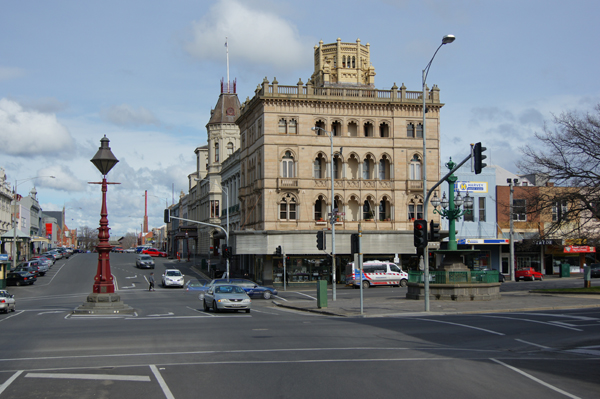
Yesterday I had to conduct some business in the country, dealings with a real estate agency that has been trading continuously in the same location since 1921. The building they occupy was built to house an earlier real estate agency in 1876. This means that I stepped into a building where real property assets had been traded for more than 134 years, dating back to the early years of the colony of Victoria in southern Australia. The staff who work inside this building do so in the most extraordinary of settings, the private office.
I know that this is apparently still reasonably common, but I was still surprised by my reaction. Stepping into a small room containing a desk, a filing cabinet and three chairs - only large enough for a single worker - seemed eccentric at best, and perversely isolating at worst. The room had a door that I sincerely hope is seldom shut, as the cell was not equipped with a window.
Of course, having no window in a room is an undesirable thing, but the truly remarkable part was the social dynamic of doing business in such a room. It was all a bit off-balance somehow, as if there might be something vaguely illicit or inappropriate about being cloistered away from other people. I sat opposite the agent, and this seemed to be alright until a third person entered the room behind me, stepping in momentarily to meet me. There was barely enough room to move, and we shuffled around in about one square metre, right on the threshold, discussing the weather and the drive up from Melbourne. As you do.
It was all vaguely comical, but I didn't feel like laughing.
Architects who work in offices generally occupy open plan studios, and so does much of the office-working world by now. To my eye, window or not, it all seemed very strange, and tradition aside I am glad I have not been sentenced to life in a private office.
Another day, another diphthong
 The blogger's tools: caffeine, free wifi and an ipad
The first Archimentor workshop was run successfully this week! Very exciting. It was an Articulation Workshop (writing and speaking) with the team at Gloss Creative, and it was a very interesting evening. We ran through three exercises, one writing and two speaking. I was impressed not just by the supreme competence and excellent attitude of the team, but also by the way that the bits I thought would be harder for them were easier, and vice versa.
The workshop process is so rewarding, as it is a ‘live beast’ - once it is up and running it really takes off in surprising directions. The process requires a thousand minute adjustments made on the fly - tone and delivery are very important, and I was yet again struck by the fact that the way a challenge is framed has a significant impact on the way it is received and carried out.
The essence of what I discussed with the team was that the different methods of articulation - of making clear, of laying out the parts - are all related. One of the evening's three simple rules was that participants were to use all their skills, and this was an allusion to the idea of 'parallel processing'. Parallel processing is the concept that the same ideas can be processed or expressed in different ways, but rather than one way being 'right' and another 'wrong', they can all exist in parallel. Valuable knowledge and insights are created by repeating the same idea in a different way, and registering the subtle differences.
To give you an example, an excellent technique for clear writing is to start by speaking what you intend to write. By explaining an idea in conversation you are provided with a ready-made logical structure, simply due to the fact that we have an intuitive understanding of how to talk to each other - where to start, what to say next, and so on. It might not be the perfect explanation, but it generates a structure that can be critiqued in a different medium. The structure can be used to lay out a piece of writing, or a diagram, an illustration, or as the backbone of a report. The technique also works in all directions. For example, for clear speaking you might start by drawing, or making a diagram, or writing, and so on. It is simple but effective.
We also discussed the process of distillation. Distillation is a reduction of the whole to its constituent parts, and it is a natural consequence of expressing an idea in different mediums or forms. Each idea may have a spoken part, a written part, an illustrated part, a photographic part, an emotional part, an economic part, perhaps even a musical part - and doubtless many others. Each part has a different value, so by jumping between the techniques of articulation, by running them in parallel, you begin to frame up a complex and subtle picture of overall idea. Just in case you are skeptical about the idea of a musical part, a friend recently used the concept in his teaching in urban design. Each student's project had to be given a theme song by the student, which was played before each presentation. It was fun, a bit silly, and genuinely instructive.
I wonder what theme song the team would nominate for the workshop? I should put it to the vote: I am sure I would be surprised.
A (very) small business launch

Hello gentle readers, I am happy to announce that I have launched my private consultancy, Archimentor. Archimentor is a loose-fit vehicle for me to provide private mentoring and coaching services, for want of a much, much better description. The list on my ultra-simple one-page website (archimentor.com.au) says it best, where it describes the Archimentor services as the provision of:
- a sounding board
- mentor
- coach
- think-tanker
- one-man workshop
- audience
- adviser
- confidante
- listener
- speaker
- designer
- writer
- thinker
Such a business seems unlikely in the extreme, especially to me - a real hot-house flower. However, I am happy to report that I have one industry client and one student client, so I am off and running. My marketing strategy is a simple one, and will require patience: I want to work on a word-of-mouth basis exclusively. As such I will take it one mouth at a time and see where it leads.
Archimentor perfectly complements my role at Williams Boag Architects, where I am engaged in design, strategy, management and winning new work. I expect that each situation will feed off the other, and evolve into something truly interesting.
Good times ahead.
Things are blurring together...
This is what a glazed facade does on a perfect winter morning: it mirrors the deep blue of the sky and the boundary between one and the other blurs just a little bit. It is a shame that our brain corrects this fleeting impression, constantly reminding us that buildings are solid and the sky is vacant. Personally I would rather the sky was solid and the buildings vacant, but what can you do?

Does anyone have any batteries for this thing?

It's the fourth of July, and yet my heart glows not for the United States, but for Italy. I photographed this statue of the Big Guy himself in the Duomo in Sorrento. It is a cold, indifferent and grey day in Melbourne, and I really wish I was in Sorrento right now. Think warm, sunny thoughts, fellow Melburnians.
Scriptorium: the ultimate writing room
This is a sketch of my personal scriptorium, which I realised I had access to all along: my living room. I have five places to sit, three of these for writing. My father has built me a 'parson's table' that sits over my armchair, which is the final jewel in the crown. The table arrives from interstate with mum and dad tomorrow, and when I have it in place I will have my own personal version of the bridge of the Starship Enterprise. Now if only I can go where no one has gone before, writing-wise. Once a nerd, always a nerd.
Many thanks to the divine Ms. Henderson for leading directly to this most apt solution to the writing cabinet problem, and for introducing me to the concept of the parson's table.

Many thanks to the divine Ms. Henderson for leading directly to this most apt solution to the writing cabinet problem, and for introducing me to the concept of the parson's table.


City landscape as rock shelf
I took this photograph today and I thought that it resembled the kind of striation you see on rock shelves near the sea. My friend David has in the past speculated about how we might design if we regarded the natural as the artificial, or vice versa. This photograph reminded me of that idea.
 Pavement, Little Collins Street
Pavement, Little Collins Street Melbourne, Venice and the shop window
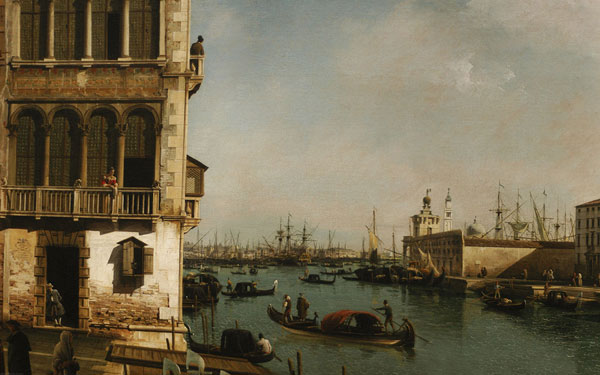
The first thing you might notice about the Melbourne General Post Office is that it is no longer a post office. It has been adapted by my firm, Williams Boag Architects, to create an historic and aesthetically pleasing, upscale shopping centre. The former postal hall was an ideal vessel for the creation of large retail space, and the delicate glass boxes that intrude into the room do not distract from its primary shape and volume.
One thing that I have noticed about the GPO, as it is called, is that it is not similar to the buildings framing Piazza San Marco in Venice in many respects, and yet there is a thread of something linking the two. The impression is fleeting, and primarily a consequence of the arched colonnade that extends along Elizabeth Street, wrapping around the southern end of the building alongside Bourke Street. There is a cafe under the colonnade, and when I have the time I like to sit beneath the arches on the little padded benches provided, pretending that I am in a far older city with a far greater appeal to the imagination than Melbourne can currently provide.
Don’t misunderstand me: I am not entirely dismissive of Melbourne's charms, and its history is both convoluted and fascinating, not without its share of chiaroscuro and drama. The night the GPO burnt down in 2000 was one such moment. Nevertheless I find myself acutely aware that Melbourne is not Venice, nor Florence, nor Rome; also, I am defiantly unwilling to abandon the wish that Melbourne was like these places in some ways, despite the Euro-centric view being so unfashionable right now.
Melbourne is not an Asian city in urban terms: it is patterned on a western new-world model, and defined in its bones by western architecture. While the current building frenzy carries a whisper of the east, the critical mass and sheer volume of activity is not there, and the patterns of the City are still primarily European.
As a city with mixed cultural and social, but strongly European physical history, I have a strong desire for this City to be more than it is. Not more than it was, perhaps, but more than it is now. Venice's greatest quality is that despite the glare and noise of relentless tourist inundation, it still maintains its shadows. La Serenissima endured for nearly a thousand years and its carapace is still with us; across such a time things begin to build up, and time and gravity conspire to settle the dust and darkness that would otherwise be kicked up by the garish process of destruction and renewal you see in less mature cities. Less mature cities like Melbourne, for example.
I once spoke to a Dutch man who had moved to Melbourne as an adult, and he didn't understand the constant destruction of buildings and their replacement with new buildings of approximately the same purpose, which are then stripped out in a decade or less to begin the process again. He didn't understand this passion for building and novelty, and having stayed in Amsterdam I can understand his point of view.
Little of what is built here has time to endure, but of course in some ways this is not such a bad thing. The thought that future generations might have to live with much of what we are constructing now inspires sadness and horror in equal measure. Fortunately there is a disposability to much contemporary construction, which is either hollow at its core or made flimsy in its superficial finish or appendages. It is fashionable to embrace this, to work with the depthless surface and celebrate life lived millimetres deep, rather than to see it as a deficit. Unfortunately enough for me, I have returned to the point where once again I perceive a building that is 'all surface' to be merely superficial: inessential and of little enduring consequence or substance.
This surface quality is not to be confused with lightness, a different beast altogether, and one that can be imparted to a block of marble by a skilled enough artisan. I know a man who carved a block of marble to appear as if it had a silk sheet draped over it. Interestingly enough, he carved the sculpture in residence in Rome. This kind of lightness, one of Calvino's six memos for the new millennium, is all about weight - the absence, the defiance of or the proximity to a great weight. Something is joyously light as a counterpoint to its alternative, which is the crushing weight of death. Everything built of lightness has weight in its shadows.
Of all the Australian designers working today, Amanda Henderson of Gloss Creative is one of a very small group who intuitively understands this, and her work is exciting to me. Gloss Creative works in the medium of lightness and not superficiality, designing things as ephemeral as 'brand experiences', which is a jargonistic way of saying three-dimensional shop displays and spaces for events. Catwalks, Race Day marquees and shop displays are all regular gigs.
On first consideration these kinds of projects would appear to be the very quintessence of the superficial, the epitome of what I decry above. In fact, a curious inversion occurs where the temporary nature of each Gloss project liberates the work from the responsibility of carrying social or cultural weight for any but the shortest length of time. It lives for its alotted time, and the time expires. At the end of that period, during which the work stands up more than well, up to 95% of the physical substance is recycled into new projects or uses, and the work is left as but a shared memory.
It comes, you see it, it conquers, and then it's gone.
Many architects are designing buildings as if they were 'brand experiences', and denying the fact that a building is a building and part of the city, not a prop or foile for an experience. My argument is simple: many 'leading' architects seem to be trying to pull off the kind of show-stopping brilliance that Henderson can pack into a single window display in a seemingly effortless fashion, but as their medium is architecture the desire is misplaced. The results are heavy, witless and laboured as examples of visual merchandising, and superficial and disposable as examples of architecture. In short, the worst of both worlds.
If our city is constantly rebuilding and never maturing, the deep shadows that make life so fascinating in the world's greatest cities may never find a place to settle here. We will be the poorer for it, but at least, thanks to Amanda Henderson and her team, the shop windows will be worth the visit.